
Sports teach us to pay attention to numbers.
Wins. Losses. Points. Assists. Touchdowns. Times. Rankings. Championships.
Those numbers matter when the game is being played.
But some of the most important things an athlete develops will never appear in a box score.
Discipline.
Confidence.
Leadership.
Resilience.
Accountability.
Relationships.
Purpose.
That is why youth sports can become much bigger than competition.
The Athlete Is Bigger Than the Stat Line
A talented athlete can get people’s attention.
Character determines what that athlete does with the attention.
Las Vegas recently saw a powerful example through UNLV quarterback Alex Orji.
Orji has received national recognition not only for football, but also for the way he serves his community. He was named among the 2026 nominees for the Allstate AFCA Good Works Team, an honor that recognizes college football players who demonstrate leadership through academics, athletics, volunteerism, and community service.
According to KTNV, much of Orji’s local service has involved Goodie Two Shoes, a Las Vegas organization that helps provide shoes to children in need.
What began as something he regularly did on Fridays eventually became something he invited teammates to experience with him.
That is leadership.
Not because somebody gave him a title.
Because he used his position to bring other people into something meaningful.
Leadership Is Not Just Being the Captain
Young athletes sometimes think leadership begins when a coach names a captain.
It begins much earlier than that.
Leadership is arriving prepared.
It is encouraging a teammate after a mistake.
It is listening when a coach is correcting you.
It is keeping your emotions under control when the game is not going your way.
It is doing the drill correctly even when nobody important is watching.
It is taking responsibility instead of finding an excuse.
It is understanding that the way you treat teammates, opponents, officials, coaches, teachers, and family members says something about who you are becoming.
A scoreboard can tell people whether your team won.
It cannot tell them whether you became someone others could depend on.
Confidence Is Built Through Repetition
Confidence is often misunderstood.
It is not always believing you are the best athlete on the field.
Sometimes confidence is simply knowing you prepared.
You ran the drill.
You practiced the shot.
You learned the playbook.
You worked on your footwork.
You came back after the bad game.
You stayed after practice.
You kept going after being benched.
Sports put young people in situations where mistakes can happen publicly.
That can be uncomfortable.
It can also teach an important lesson.
One mistake does not have to determine the next play.
That lesson travels well beyond athletics.
The Game Teaches You What to Do After Things Go Wrong
Every athlete eventually loses.
Every athlete misses.
Every athlete gets tired.
Every athlete has a moment when something does not go according to plan.
The real question is what happens next.
Do you blame someone?
Do you quit?
Do you stop listening?
Or do you learn, adjust, and come back?
Resilience is not pretending disappointment does not hurt.
It is learning how to move forward without allowing one difficult moment to define everything that comes after it.
New Sports Can Create New Opportunities
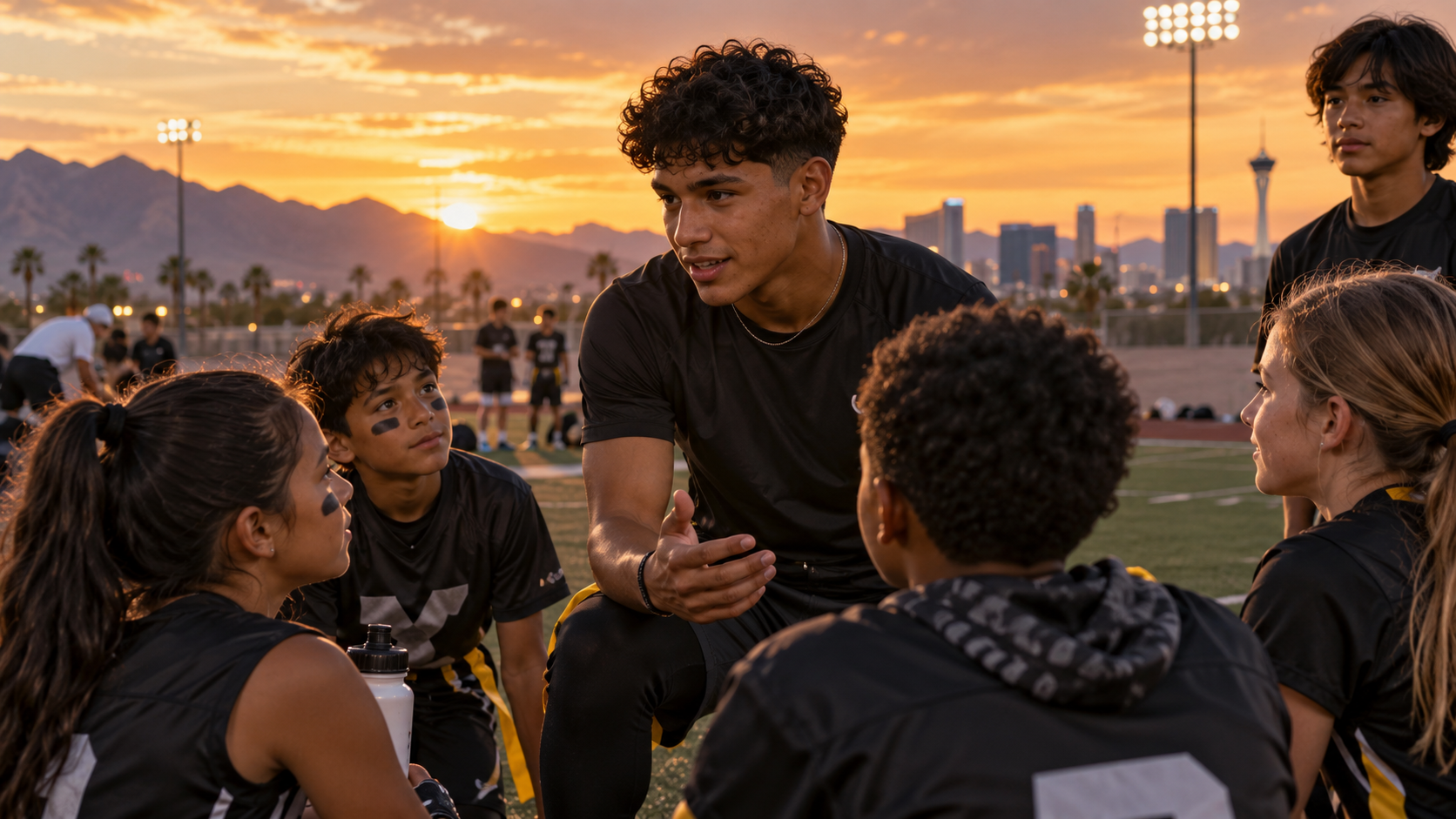
The growth of girls flag football is a strong example of how quickly athletic opportunity can expand.
KTNV recently reported that the Las Vegas Flag Football International Invitational brought 45 teams to Southern Nevada, including teams from the United States, Canada, and Mexico.
The report also highlighted the dramatic growth of girls flag football nationally. Participation has climbed from roughly 11,000 high school girls during the 2018 to 2019 school year to more than 100,000 today.
That growth is creating more than games.
College scouts attended the Las Vegas tournament, and athletes had access to recruiting resources designed to connect them with college coaches.
The sport is also headed to an even larger stage.
The International Olympic Committee has officially included flag football in the Los Angeles 2028 Olympic Games, where the sport will make its Olympic debut.
For a young athlete, growth like this means possibilities can change quickly.
A sport that once had limited opportunities can develop high school programs, club teams, tournaments, recruiting networks, college pathways, coaching opportunities, and international competition.
That is why exposure matters.
Sometimes young people cannot imagine themselves in a space simply because they have never seen the space exist.
Sports Can Help Young People Find Their Voice
A team creates situations where communication matters.
You have to ask questions.
You have to call out assignments.
You have to encourage people.
You have to learn when to speak and when to listen.
You have to work with personalities that may be very different from your own.
For some young people, sports become one of the first places where they discover that their voice matters.
That confidence can eventually show up in classrooms, interviews, jobs, relationships, and leadership roles.
Your Teammates Are Part of Your Development
Sports are rarely an individual experience, even when the competition itself is individual.
Someone coaches you.
Someone trains with you.
Someone challenges you.
Someone encourages you.
Someone competes beside you.
Someone may eventually look up to you.
Learning how to be a good teammate is a life skill.
It means understanding that not every day will be about you.
Sometimes your role is to score.
Sometimes your role is to defend.
Sometimes your role is to lead.
Sometimes your role is simply to support somebody else while they have their moment.
Strong teams require people who understand all of those roles.
Use Your Platform Before You Think You Have One
Young athletes sometimes imagine that giving back should happen later.
After the scholarship.
After the championship.
After the college offer.
After becoming well known.
But leadership does not require fame.
You already influence people.
A younger athlete may watch how you practice.
A teammate may notice how you respond to adversity.
A sibling may copy the way you speak about your coaches.
A community may remember that you showed up when help was needed.
Orji’s example is meaningful because service became part of his routine while he was still competing, training, recovering, and managing the demands of being a college athlete.
Success and service do not have to wait for one another.
Opportunity Is Bigger Than Going Pro
There is a tendency to measure athletic success by how far someone goes in the sport.
Did they make varsity?
Did they receive a scholarship?
Did they play in college?
Did they become a professional?
Those are exciting accomplishments.
They are not the only outcomes that matter.
Sports can introduce young people to coaching, sports medicine, athletic training, broadcasting, journalism, marketing, event management, officiating, strength and conditioning, physical therapy, administration, analytics, and countless other career paths.
An athlete may eventually leave competition and still remain connected to sports for the rest of their life.
The experience is bigger than one uniform.
Play for Something Bigger
Compete.
Work hard.
Chase the championship.
Improve your numbers.
Celebrate the wins.
Learn from the losses.
But remember that the scoreboard only tells one part of the story.
The person you are becoming while you compete matters too.
The discipline you develop matters.
The people you encourage matter.
The way you respond when things go wrong matters.
The opportunities you create for others matter.
The way you use your influence matters.
One day, the final whistle will sound.
Make sure you leave the game with more than a score.
